From Shelf Stacker to Software Engineer: The Story of Robert at Niverplast
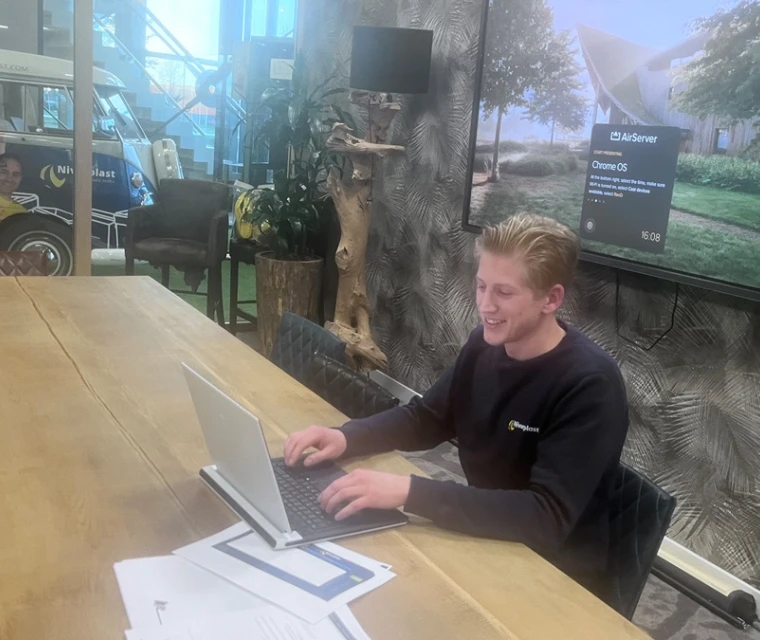
Robert Ligtenberg (25 years old) | Software Engineer
Last year, Robert celebrated his 10-year anniversary at Niverplast. It all started with holiday work. Before that, he worked at a construction company opposite Niverplast, when he was just 14 years old. A real go-getter, you could say. From his holiday job at Niverplast, he would cycle to the local supermarket at half past four to do shelf stacking.
“At age 16, I was already in South Spain.”
Robert knew early on that he wanted to do something with technology. He was - and still is - crazy about cars and enjoys tinkering with them. After the holidays, he started a new education; Mechatronics at level 3 via REMO. A combination of work and learning, which meant he could nicely stick with Niverplast. During his holiday job, he got to know the Stand Alone machines and worked on System Integration (SI), where complete packaging lines for customers are built. Robert immediately liked SI. After completing level 3, he immediately followed it up with level 4. Robert: "If I was ahead of schedule at school, then I could join an installation for a week." So he was already in South Spain at age 16. Because Robert often went abroad, there were times when he joined a special class to make up for missed school hours. Many boys who worked in the field service at Voortman were also in that class.
Lots of fun while traveling
Robert still enjoys traveling. "The variety you have, first inside and then outside, is beautiful. However, you shouldn't expect to see the whole country, but we have Sundays off, so you can see some things." Robert has visited many countries in Europe and has also ticked off America. "When you're traveling with a fun group, you really have a lot of fun. And oh well, you remember the good things and forget the bad ones so easily."
No boss, but still responsible
Robert learned the theory at school, but he gained most of his experience in practice. "At first, you were the 'intern' who went along, but you really grow," says Robert. Eventually, he was present at the kick-offs when a project was sold. Then he went through the important customer requirements and specifications with the project engineer, those kinds of things. At one point, Robert even became the driving force behind large installations at the customer's site. "Then someone came to an older colleague to ask who the boss was, well, at Niverplast we don't work with bosses and managers, but I was the one they had to go to. I was the youngest of the group, handled all the communication, and guided the project from A to Z. Then you saw them look strange, haha."
"I was the youngest of the group, but I was the one they had to go to."
Transition to Software Engineering
The challenge was a bit gone in the workplace. "I had been there for over 8 years and knew everything, I had seen everything." At school, Robert had already come into contact with some software assignments, which he found interesting at the time. It was time to seriously explore his interest in software engineering. He had discussions about the possibilities and got the green light to take a new direction. Robert: "They said, 'Just sit next to a software engineer and see if you like it. He can then see if there is potential." So said, so done. Robert was scheduled for two weeks off to shadow. And so, a whole new learning trajectory followed.
Advantage from experience with assembly
"It was a completely different experience," says Robert as he looks back on the switch. "I knew a little bit about the basics of programming, but I had to learn a lot. When you come home, you're mentally exhausted because you've been dealing with complex problems all day." At first, Robert got simple projects. They took his learning curve into account in the planning. After six months, he was already working independently and completed his first project. "It was relatively simple work, just conveyor transport," says Robert. Now he works independently on versatile projects. Much of the programming work is done at Niverplast, but for fine-tuning, it's essential to work at the customer's location. "There, you deal with the exact speed of the product flows, so you can really optimize to make the line run smoothly. I have the advantage here that I have also been on the shop floor."
Asking colleagues
As a software engineer, Robert encountered new challenges. He explains: "Sometimes you encounter unexpected problems, like malfunctions you've never seen before or components that are new to you. In such moments, it's important to gather information from others, check if someone has ever dealt with a similar problem, or if certain components have been used before. Asking questions in time saves time and money. Sometimes you make typos that you no longer see yourself, while someone else notices them immediately." Robert: "In terms of software, you work a lot on your own." Still, Robert tries to keep in close contact with the people on the shop floor. Robert continues: "There is currently a team working in Germany, so I try to call a few times to see if I need to take anything into account and if they encounter any issues. When work is being done in the workshop, you can simply drop by, with a cup of coffee, go over things for a moment."
Niverplast as an employer
Robert doesn't see Niverplast as a standard company. Freedom and independence are important core values. "You go to the customer to set up a line, then you are responsible for that. Also many other things, like hotels and transportation, you organize yourself." Freedom is nice, but Robert notices that this sometimes leads to frustration because it's not always 100% clear who is responsible for what. Still, Robert is very happy with Niverplast as an employer. "I've been working there for 10 years, that says enough, otherwise I wouldn't have lasted this long!"
The future
Within Software Engineering, Robert can go on for many years. Robert: "It will take a while to really reach a higher level." For example, he now knows the telcamera lines well, but he has never done a project with palletizing, so if that ever comes up, he would like to do that. "I have indicated this in the planning, that I would like to gain experience with that. Of course, you have to clearly indicate what you want, otherwise it can take a few years!"