Gerrit Jan Nieuwenhuis runs an extraordinary company with Niverplast
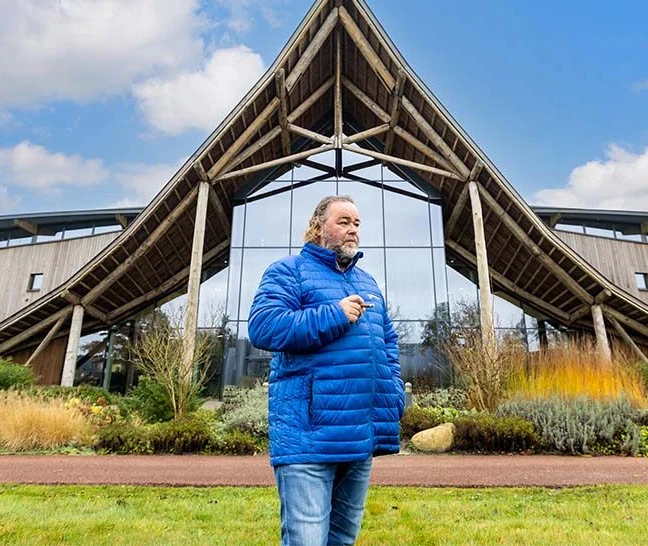
''My greatest strength is loving people"
No management, no hierarchy, and no job descriptions. Sounds like a poor business plan, doesn’t it? Gerrit Jan Nieuwenhuis and his company Niverplast are eager to prove otherwise. Yes, the machine manufacturer from Nijverdal is anything but conventional. Behind the doors of their unique, circular company building lies a highly successful business that designs and builds packaging machines for customers all over the world.
It's easy to lose your way in Niverplast's massive company building. And we have to admit: we speak from experience. The entrance, with its Efteling-like façade, is impossible to miss, and the doormat reading ‘Mooi da’j d’r bint’ (Great to have you here) immediately sets a warm tone. A sign points us upstairs, and a walkway takes us over a huge hall filled with machines and busy employees. But then? No more arrows to guide us, and there are so many directions to choose from. So, we do the logical thing and ask for help at the nearest desk. With a laugh, they call "the big boss." Though, at Niverplast, that title is actually off-limits.
Fortunately, Gerrit Jan Nieuwenhuis comes to our rescue in no time. “Lost your way?” he asks with a grin. “Ha, that’s exactly the point! We deliberately don’t have a reception desk or receptionist here. People just wander through and get a little lost. It gives them plenty of time to look around, take it all in, and get a feel for the place.”
In his casual shirt, jeans, and yellow clogs, Gerrit Jan leads us to his office. “To be honest, I did hesitate a bit,” he says, nodding at his feet. “I always wear clogs, so I thought: why not now? This is who I am, and it’s what makes me feel comfortable.”
Unorthodox
It says everything about Gerrit Jan: he is far from your average entrepreneur. He doesn’t follow the herd but thrives on doing things differently. He relies on his intuition, vision, and moral compass. One moment, he expresses a strong opinion, and the next, he reflects deeply, offering philosophical and wise insights. One thing is clear: he always charts his own course.
“I call myself an anarchist,” he says about this. “I reject structure, hierarchy, and power. I just don’t believe in them. That’s why, at Niverplast, we don’t have a management team, no managers, and no job or task descriptions. We believe that freedom and responsibility form the foundation of enjoyable work. Most of the people who work here have a partner, a family, a mortgage. They care for their parents and are also volunteers at their local clubs. Should those people come here so I can tell them what to do?” Gerrit Jan wonders aloud.
He shakes his head. “I think that’s patronizing. We like to do things our own way here. Unorthodox? Yes, you could definitely call it that!” His booming laugh fills the room. “The rebellious things we do, they’re a bit of resistance. Isn’t that part of being human? That little child in all of us that enjoys doing something daring or out of the ordinary? At Niverplast, we just embrace it. At parties, we like to build bonfires, and we even have a motocross track here.”
Gerrit Jan nods toward the window, a mischievous grin spreading across his face. “That’s not allowed, but it works! Not everything needs to be safe or responsible, as long as it’s always done with respect for others. For instance, I sometimes smoke a cigar in my office, but I’d never do it if someone minded. I don’t believe in a smoking ban, but I absolutely believe in a respect mandate.”
Twelve Trades, Thirteen Mishaps
Gerrit Jan’s unorthodox nature was apparent from an early age. Growing up in a typical working-class family in Rijssen, he always felt different from those around him. “I’ve always felt lonely. Misunderstood,” he reflects. “I read different books, listened to different music, and had different views. I was drawn to the stories of people who achieved great things in history—Mandela, Martin Luther King, Jesus, Gandhi. They’re my heroes.”
He pauses for a moment, fiddling with the cigar box on the table. “You know, as a kid, I often understood people better than they understood themselves. I was extremely empathetic. That’s just part of who I am, but it’s not always a good thing. Not everyone needs help. And if you always try to help everyone, it can sometimes come at your own expense. There were times I felt like a completely drained cow. That was my own doing. I’d torment myself endlessly if I hurt someone or said or did the wrong thing. But I’ve learned it’s okay to make mistakes. If you make amends and apologize, that’s enough. Your greatest strength is often also your biggest weakness, right? My greatest strength is loving people. And at the same time, that’s my biggest threat.”
The sensitive and empathetic side of Gerrit Jan was evident early on, but so was his knack for technology. “I was a bit of an inventor,” he says with a laugh. “I loved playing with Plasticant, but I never followed the instructions from the manual. I came up with my own ideas and figured out how to make them work. I’d grab a battery or a bike dynamo and create things that technically weren’t supposed to work. I’m terribly messy, so my creations weren’t very precise. But that didn’t matter to me—it was all about creating something beautiful.”
As he strokes his gray beard, he reflects further. “At school, I was kind of overlooked. I was one of the worst students in class, but that was mostly because I didn’t know whether ‘word’ should be spelled with a d or a t. On the other hand, I was the best at mental arithmetic, but somehow no one noticed.”
Eventually, Gerrit Jan pursued training as a car mechanic. He found electronics and mechanics fascinating, but he didn’t end up working in that field. “Being messy didn’t seem like a great fit for a mechanic,” he chuckles. “After that, I had a ton of different jobs. The summary? Twelve trades, thirteen mishaps, haha! I’m stubborn, incredibly headstrong, and I don’t deal well with authority. Most bosses were relieved when I left—they couldn’t handle me for long.”
Ultimately, Gerrit Jan struck out on his own. “I became a salesperson because I enjoyed trading. I think I inherited that from my father. Besides working in the factory, he traded cows. I loved tagging along as a kid. I like giving people something that makes them happy. In a way, I’m like a preacher. But instead of spreading the word of God, I was selling packaging materials. Why? That was kind of random. I already knew the market from working at a packaging company. I found the process really interesting, so I decided to dive deeper into it.''
Everything Comes Together
Gerrit Jan was just 24 years old when he started his own business. A bold move, especially with a mortgage and a young family to support. And it wasn’t without its challenges. “I believed in it, but it certainly wasn’t easy. It was a process of trial and error,” he recalls. “Two steps forward, one step back. And that can be quite a shock when you suddenly find yourself short on cash. We had our share of financial worries during that time. But gradually, things got better. You gain some loyal customers, the first employees join the team, and little by little, the business grows.”
The trade in packaging materials became a success, but that was just the beginning for Niverplast. Gerrit Jan’s inner inventor frequently came to the surface. “I always see opportunities that haven’t been taken yet. And that leads to new ideas and concepts. For instance, we developed the 'Easy Open Bags,' and a few years later, our first packaging machine followed. A company in the lily industry approached us to create a machine that could automatically place bags into crates. Of course, we said yes! That machine was a hit, and soon more bulb traders wanted it. Word spread quickly. There are moments in life when everything comes together so perfectly that you almost feel it’s divine intervention. This was one of those moments.
A friend once told me, ‘Luck is where preparation meets opportunity.’ That’s absolutely true. Sure, you need a bit of luck, but you also have to recognize the opportunity when it comes and grab it. It’s like a striker receiving a perfect pass. It only works if you’re in the right place at the right time. And at that moment, we were perfectly positioned.”
But it didn’t stop with that one machine for the lily industry. Today, Niverplast’s packaging machines are shipped all over the world, primarily for the food industry. In 2007, the company had 30 employees; now, that number is approaching 300, including Gerrit Jan’s son, Richard. “Our workforce doubles every five years,” Gerrit Jan explains. “Our current building hasn’t been big enough for a while, so we’ve already built another one next door. And in the coming years, we’ll develop another facility further down the road. Once everything is filled, we’ll have a thousand people. How did we grow so much? Simple: one at a time,” he quips.
“Growing big was never our goal; we just want our customers to buy from us. We genuinely believe no one loves them as much as we do. I truly believe no one will make you happier than Niverplast. We’re not perfect, but we care so deeply about our customers—it’s almost crazy. We want the very best for them and will tackle any challenge to achieve it. I used to get clammy hands from difficult projects, but now I see them as a positive sign. It means it’s even harder for our competitors. They don’t have the same passion we do. That’s our secret weapon, and I firmly believe in it.”
It’s hard to deny Gerrit Jan’s passion. Passion for the machines Niverplast develops, for his team, and for the customers. He radiates enthusiasm, and it’s infectious. But it’s not just Gerrit Jan—this energy is felt throughout the entire company. Niverplast is all about fun, cheerfulness, and humor. A lot is done with a smile and a wink. In a promotional video, Team Niverplast struts around shamelessly in cow costumes, wooden clogs make appearances at trade shows, and a roadside banner boldly proclaims: ‘Boundary-breaking happiness.’
Gerrit Jan’s booming laugh echoes again: “Yep, that’s who we are. If someone thinks that’s too much, they definitely shouldn’t apply here. We take our work very seriously, but absolutely not ourselves.”
Connected to Africa
Niverplast likes to do things differently. That much is clear. Even as you approach the company building, you notice it immediately. While the entrance is inspired by the whimsical style of the Efteling, the rest of the building feels more like an African lodge. This connection to Africa is even more evident in Gerrit Jan’s office, where a large photograph graces the wall, and souvenirs from his travels are scattered throughout. Gerrit Jan, Niverplast, and Africa are undeniably intertwined.
“Africa holds a special place in my heart,” Gerrit Jan confirms. “That bond began after a family trip to Kenya. On that trip, we learned things we hadn’t fully realized before—the extreme poverty, what it means to be truly without opportunities. It hit me hard. I went from rags to riches myself, so for a long time, I believed that anyone could do the same. But that’s just not the case. There are incredibly talented people waiting for their chance, but that chance never comes. And they don’t even have the money to go out and seek it.”
Niverplast’s slogan is “Passionate People” for a reason, and Gerrit Jan felt a deep desire to help children in Africa. He decided to support the charity organization Compassion. Since 2009, every permanent Niverplast employee has sponsored a child in Kenya. “This gives children the opportunity to attend school, eat healthy meals, and access medical care. It’s our way of contributing to their development and helping them build a better future. It goes beyond just financial support. Our colleagues regularly send letters, photos, and other necessities to their sponsored children. They can also choose to support other initiatives, like a Mother and Baby Program, which provides essential care during the crucial first thousand days after birth.”
For Niverplast’s 25th anniversary, the entire team traveled to Kenya to meet the children they sponsor. The experience created an even greater drive to help. “Seeing the situation with your own eyes leaves a lasting impression. For our 60th anniversary, we’d love to organize another trip like that. I’m also considering supporting projects in other parts of the world. You know, I’m a bit bothered by the ‘cuddly’ image of Africa. It sometimes feels like people assume there’s no need to help elsewhere in the world. I’d actually like to shift my focus to a region that receives less attention. Everyone admires efforts to help Africa, but a project in Kazakhstan? That’s a lot less glamorous. And that really gets to me.”
Unemployed
Since 1986, Gerrit Jan has poured his heart and soul into building Niverplast. But after nearly forty years, his role has started to shift dramatically. Together with his wife Ineke, he now spends more time abroad—sailing or enjoying their home in Spain. “The company runs smoothly, even when I’m not there,” Gerrit Jan says. He pauses for a moment before continuing, “That’s a double-edged sword. My whole life, I’ve looked for people who could do what I do. And I succeeded, which has essentially made me unemployed. Honestly, I find that pretty painful.
I deeply appreciate the fact that I can go sailing while my colleagues keep everything running perfectly here. But who am I now, if I’m no longer ‘Mr. Niverplast’? To be honest, I’ve gone through a bit of an identity crisis. Niverplast is who I am. I’ve dedicated my entire life to this company, and it embodies everything I believe in.”
Gerrit Jan looks around his office, reflecting before he continues. “I’ve received so much appreciation from people who associate me with the company. But if things went wrong with Niverplast tomorrow, their perception of me would change. It feels fleeting, almost unsettling. And yet, I understand it. Of course, you applaud when there’s a goal, but do you applaud when there isn’t? I wrestle with that sometimes. But slowly, I’m stepping further into the background. That’s a good thing because I’m very happy with where we are now. Proud? Definitely. Although I think ‘grateful’ is a better word.”
While Gerrit Jan is taking a step back, he certainly hasn’t severed ties with Niverplast—not by a long shot. “They call me the gnome around here,” he says with a proud laugh. “I hope I can keep that title. I no longer want to be Papa Smurf with all the answers. I’m the senior gnome who still loves to be part of things. Sometimes I’m here in the office, other times I join the guys to visit a customer. I enjoy that. I also stay involved in strategic decisions and want to keep sharing my thoughts.
I have no doubt Niverplast will be just fine. We know who we are, who we want to be, and what we stand for. We’ll see where that takes us. For a long time, I thought my happiness was tied to the size of this company, but that’s nonsense. We don’t need that. We’re no longer focused on growing bigger; we’re focused on making our customers happy. And that’s what makes you grow. If our customers keep asking for machines that help them in their work, we’ll continue to grow. But that growth should never come at the expense of happiness. Happiness is our greatest asset.”
