With a detour, Sebastiaan found the job that suits him perfectly
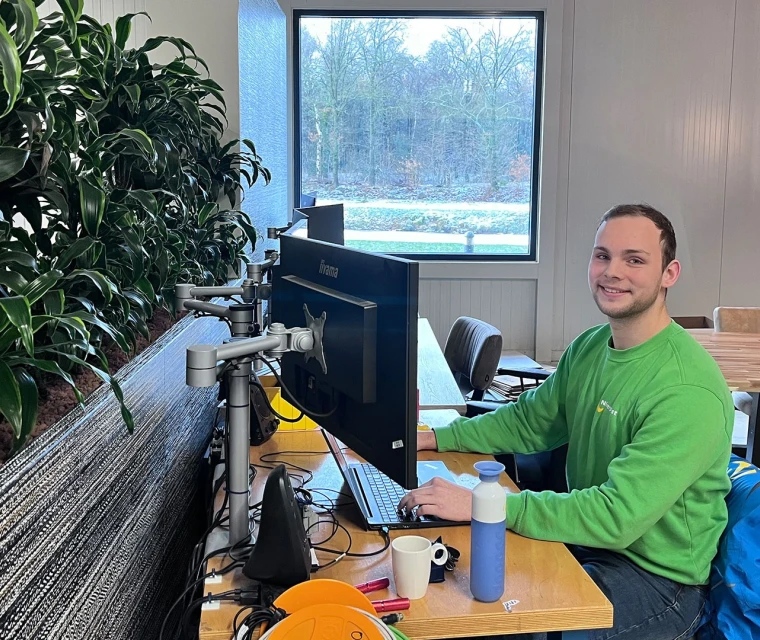
Sebastiaan Dommerholt (23 years old) | Software Programmer
5 years ago, Sebastiaan Dommerholt first set foot in Niverplast. Through the main entrance, over the large walkway, quite nervous about his upcoming job interview for an internship. The initial tension quickly disappeared when he ran into the first Niverplast employee. They immediately struck up a conversation. He was asked if he also likes Grolsch beer and the ice was broken.
"I had heard about Niverplast from my brother," Sebastiaan says, "who also did an internship there, but in a completely different area, something in sales, I think." It wasn't until later that Sebastiaan discovered the company's specialization in constructing complete packaging lines. This realization came while he was searching for a suitable internship opportunity. At the time, he was pursuing Level 4 studies in Electrical Engineering at Hoornbeeck College in Amersfoort, a reformed secondary vocational education (CTE). His father had also attended school there, so it was considered a good education. And it aligned with his background and values. After visiting an open house, the decision was quickly made.
Hands-on work
Sebastiaan enjoyed working with electricity; which he had already experienced during his first internship at van Dam in Rijssen. On the construction site, he had tasks like pulling cables through conduits, installing power outlets at strategic locations, and wiring switches for lighting circuits, among other electrical installations. This hands-on work suited him well. However, the educational path he was pursuing leaned heavily towards theory. It wasn't until his internships that Sebastiaan began to bridge the gap between classroom learning and practical application. During his time in the Projects department (now System Integration) at Niverplast, Sebastiaan had a breakthrough. "It all clicked for me here," he recalled. While many of his classmates had prior practical experience, Sebastiaan realized there was still much for him to learn in a real-world setting. As the coursework at school delved deeper into the subject matter, Sebastiaan found it increasingly challenging to keep pace with the lessons. "I thought; what am I actually doing in this education, I'm not enjoying this at all." Sebastiaan decided to stop and choose practical education first. He ended up at REMO in Rijssen.
From level 4 to level 3
He alternated between school and practical experience, spending two days in the classroom and three days at Niverplast. "Whenever I learned something at school, like reading circuit diagrams, I would immediately apply it on the factory floor. Everything began to make sense," he explains. He discussed with his teacher at school what he had already learned, which allowed him to skip the first year. His parents supported his decision to switch paths, prioritizing his enjoyment and fulfillment. And Sebastiaan found just that. "Whether I wanted to connect a control panel or calibrate a metal detector, I could experiment freely. Afterwards, someone would review my work. If there were mistakes, they patiently explained and guided me through the corrections. That approach really worked for me," Sebastiaan reflects. He successfully obtained his certification, marking the completion of his training.
Learning new things
Sebastiaan showed initiative; he kept asking for new things to learn. "People appreciate it when you proactively ask for new tasks. They don't keep an eye on you all day. If you keep doing the same work, no one will ask if you want to learn something else." After completing his education, Sebastiaan worked in System Integrations for a few years. He was regularly abroad for installations at clients' sites. During some of his assignments, the programmer arrived just in time to test and fine-tune the production line. "Seeing a fully operational line that I had helped build in the workshop was incredibly satisfying."
Taking care of the installation of packaging lines became quite a piece of cake over the years and Sebastiaan was ready to learn something new again. So, he suggested if he could shadow a software programmer and perhaps even pursue training in that area. Sebastiaan: "This suggestion was met with enthusiasm. They said: 'Go for it! Arrange it!'"
“Seeing a fully operational line that I had helped build in the workshop was incredibly satisfying."
Working as a software programmer
He didn't fancy going back to school completely, but he found a suitable part-time education. For this, he had to take an entrance exam. "This was a bit like an IQ test. Making connections, calculations, those kinds of things, he recalls. I thought it was rather standard and not particularly exciting. However, I ended up failing due to difficulties with the Dutch language. If the course had been conducted in English, I would have passed."
That setback was disappointing for Sebastiaan. It's only possible to take the test once a year, so his chance was gone. However, a solution was found: Sebastiaan began shadowing an internal programmer to explore his interest in the field. He plans to attempt the exam again in the future. Currently, he shadows an experienced PLC programmer in the testing department of the bag placing machines. "But he just had a baby, so I'm now watching the shop on my own, haha."
“If the course had been conducted in English, I would have passed."
Advanced way of programming
It worked out nicely for the other programmer; this arrangement allows them to focus more on R&D projects. Tasks like installing programs with the laptop, setting up safety relays are now handled by Sebastiaan. For more complex issues, like troubleshooting certain bag lengths and box sizes, Sebastiaan's colleague lends a hand. "But by now, I've become proficient at handling those as well. Even when a customer requests specific movements or additional cylinder strokes, I can manage it," Sebastiaan explains.
The programming approach at Niverplast is highly advanced, especially with machines like the CombiPlast. Behind its complexity lies a great deal of intelligence. Sebastiaan learned programming directly on the factory floor, using structured text in Codesys. "Everything is in English, which suits me better than Dutch," he adds with a laugh.
“When a customer requests specific movements or additional cylinder strokes, I can manage it."
Back to System Integration (SI)
Sebastiaan is really happy that he can continue this way. He's already several steps ahead of where the education typically begins. His goal is to eventually return to System Integration to work on the larger projects. "I want to keep moving forward and not do the same thing all the time. In System Integration, you get to craft your own program each time, tailoring it to your specific configuration and coding it yourself. There's still a lot for me to learn, because I'm not at that level yet!"