Six robots do the work of sixty people
This article appeared in de Volkskrant on August 20th 2024.
Robotization helps Picnic achieve first profit: ‘Six robots do the work of sixty people’
Picnic has made its first monthly profit from home grocery deliveries, thanks largely to robotization, which has halved the need for staff.
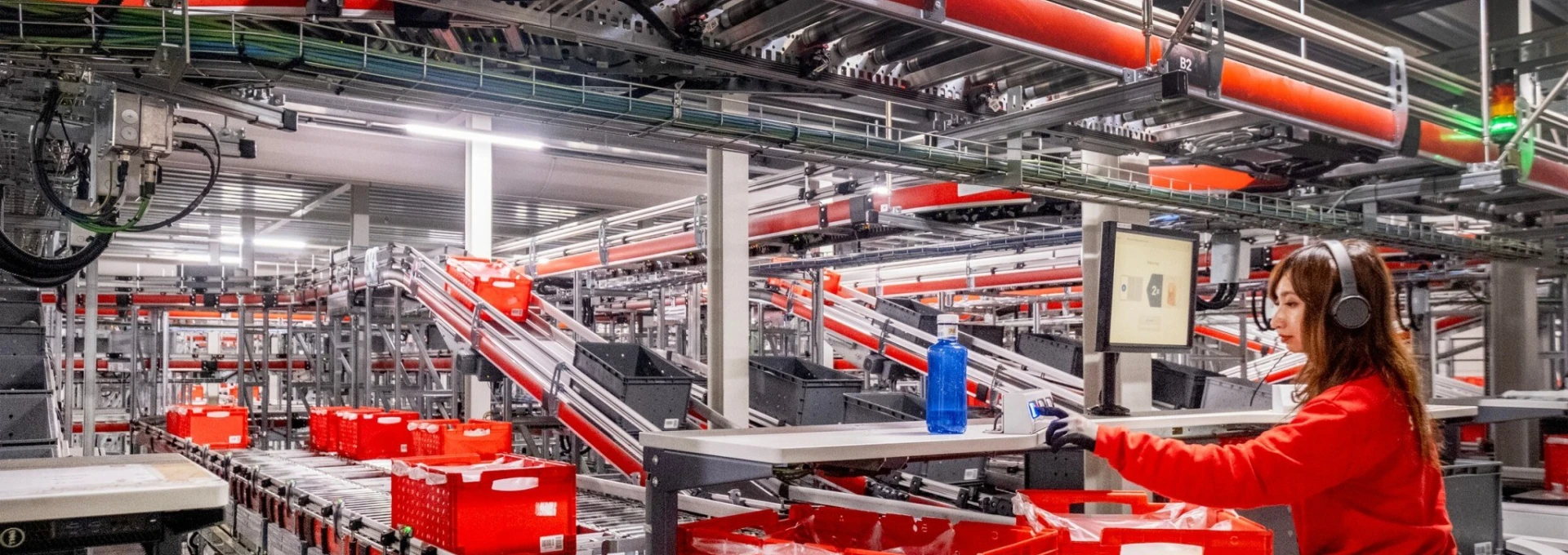
The fully automated journey that thousands of crates make every day through Picnic's distribution center in Utrecht ends at the "dispatch robot." Three at a time, a robotic arm slides the grocery-filled crates into a rack. A few hours later, that rack will be transported through a neighborhood in the Netherlands on an electric vehicle.
"This used to be done entirely by hand," says CEO and co-founder Michiel Muller as he looks on with satisfaction at the robotic arm. The crates slide into the rack with precision and steady movement. "For people, this was heavy work, where employees also had to scan barcodes. This is so much better."
The robotization in Picnic's warehouse near Utrecht is one of the reasons why the grocery delivery service briefly turned a profit for the first time since its founding, at the end of last year. The fact that this profit only applied to December and only to the Dutch branch does not dampen Muller's enthusiasm. According to him, it proves that Picnic is now "super-efficient." He sees it as an encouragement to continue investing in rapid expansion.
Muller also has key investors on his side. Last year, the German supermarket chain Edeka and the Bill Gates Foundation invested hundreds of millions in Picnic to drive growth in the Netherlands, Germany, and France. This led to an operational loss of 220 million euros for the entire group, but also to a 34 percent increase in revenue, reaching 1.23 billion euros. In the Netherlands, where Picnic began delivering groceries in an Amersfoort neighborhood in 2015, revenue grew by 28 percent.
The 220 million euro loss resulting from all these investments does not alarm the investors. "You have to spend money to make money," says Muller.
At the beginning of this year, Klaas Knot, president of De Nederlandsche Bank, suggested that the large distribution centers in the Netherlands could be reduced. The work in these centers is largely done by migrant workers, and the added value to society is limited, Knot argued.
Mostly Dutch Employees Picnic does not work with employment agencies that bring in workers from abroad, Muller emphasizes. "We mainly employ Dutch people." However, he fully agrees with Knot's plea for higher productivity: "That's exactly what we're doing here."
Walking through the Utrecht distribution center, it's easy to understand the founder's optimism. As the crates roll by softly above, below, to the left, and to the right, Muller explains that building the Utrecht center cost around 100 million euros. "But we developed the entire installation ourselves, including the software that controls it."
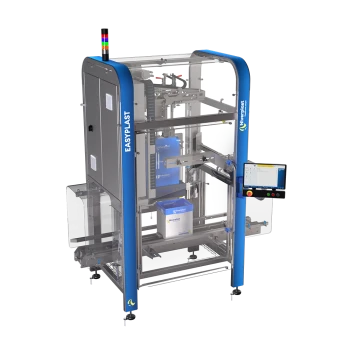
"We have six bagging robots here, and they now take over the work of about sixty people."
He pauses at a device that picks up small plastic bags, blows them open with air, and then perfectly hooks them into a red crate. Three bags side by side, and then on to the next crate. It was complicated and time-consuming to build this device, but the advantage is enormous, says Muller. "We have six bagging robots here, and they now take over the work of about sixty people."
Packing Staff Still, about 500 people are working in Utrecht. Groceries are still manually distributed among the three bags that the robots have stretched in each crate. Packing staff are stationed at their posts. The machine feeds supply crates from the right, each containing a single type of product: cat food, water bottles, toilet paper. A computer screen shows the employees how many products should go into each bag.
This work is difficult to replace with robots, Muller explains. "Packing a head of lettuce or a bunch of bananas properly is difficult to automate."
With 500 people, the number of employees has been halved. The productivity of those employees is therefore twice as high.
Now that the first robotized distribution centers are up and running, the advantage is only growing, Muller observes. "We have far fewer development costs." Meanwhile, dozens of engineers are constantly working with the distribution staff to fine-tune the system. "Percentage by percentage," productivity continues to increase, the CEO notes with satisfaction. "We will recoup this investment within a few years."
Want to save on manual labour as well?
Our E-commerce packaging machines
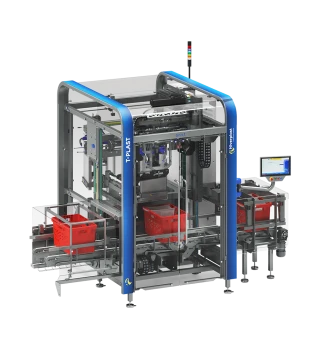
Multiple bag placing
Discover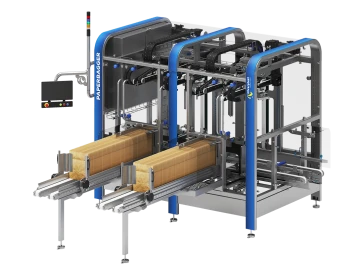
Paper Bag placing
Discover